
Key Points
- A skylight is a roof penetration, so the unit, curb, underlayment, and flashing must work together to shed water.
- Water around a skylight does not automatically mean the glass or frame needs replacement. The source may be failed flashing, damaged shingles, underlayment, roof sheathing, or the skylight itself.
- The safest decision is based on an inspection that separates a flashing repair from a skylight repair, a replacement, or a broader roofing issue.
Why Skylights Need More Than a Good Seal
Homeowners often ask one simple question after seeing a ceiling stain near a skylight: “Do I need a new skylight?” Sometimes the answer is yes. Often, the actual problem is somewhere around the opening, such as deteriorated flashing, damaged roofing materials, or water entering beneath the unit.
The U.S. Department of Energy’s Building Science Education program identifies skylights as a common source of water infiltration and recommends checking the skylight, surrounding roof covering, flashing, roof sheathing, and framing before deciding whether to repair or replace it. Rewrite the review section into narrative-style customer case studies.
For each review:
- Create a descriptive, specific case-study heading.
- Explain the project situation and context, including storms, damage, renovation needs, or other relevant circumstances mentioned in the review.
- Describe the homeowner’s main concerns, problems, or decision points before hiring the company.
- Turn the review into a natural customer story rather than simply summarizing it.
- Integrate short, relevant quotes from the original review naturally into the narrative.
- Include the original review link for verification.
- Do not invent project details that are not supported by the review.
- End each case study with a short practical lesson or takeaway showing what another homeowner can learn from that customer’s experience.
Keep the writing specific, credible, useful, and based on real customer experiences rather than generic marketing language.
That distinction matters in Delaware County, where homes can include older roof assemblies, additions with different roof slopes, masonry chimneys, and complex transitions between original and renovated sections. A skylight installation should be treated as part of the complete roof water-management system, not as an isolated window project. Strath Haven’s skylight services can be considered when a home needs skylight installation, repair, or replacement as part of a broader roof evaluation.
What Flashing Does Around a Skylight
Flashing is the water-shedding material installed around a roof penetration or transition. Around a skylight, it helps direct rainwater around the unit and back onto the roof surface instead of allowing it to collect at the frame or travel beneath the shingles.
The National Roofing Contractors Association explains that skylights require careful flashing details. Its guidance describes the use of separate components such as apron, step, cricket or backer flashings, and counterflashings, depending on the roof system and skylight design.
The exact configuration depends on the roof slope, the skylight type, the surrounding materials, and the manufacturer’s installation requirements. That is why applying extra roof cement around a leaking skylight is not the same as correcting the flashing system. If the issue extends beyond the skylight opening, Strath Haven’s roofing repair services may be relevant. Sealant can sometimes serve as part of a repair, but it should not be used to conceal a drainage or installation problem.
Common Warning Signs Around a Skylight
| What you notice | What it may indicate | Why the distinction matters |
|---|---|---|
| Brown or yellow ceiling stain | Water has entered the interior finish | The visible stain may be downstream from the actual entry point |
| Peeling paint near the skylight | Repeated moisture exposure or condensation | The source could be the unit, flashing, roof covering, or indoor humidity |
| Damp framing or insulation | Water may have reached the attic assembly | Hidden materials may need evaluation before the leak is closed up |
| Missing or damaged shingles beside the skylight | Roof covering may be allowing water beneath the flashing | A skylight replacement alone may not solve the issue |
| Water appearing after wind-driven rain | A vulnerable flashing transition or exposed roof area | The leak may be intermittent and difficult to locate from indoors |
A homeowner should not assume that the location of the interior stain identifies the precise source. Water can travel along roof decking, framing, insulation, and finishes before becoming visible.
How a Professional Skylight Assessment Separates Repair from Replacement
A sound assessment starts inside the home. The Department of Energy recommends looking for peeling paint, water stains on framing, and other signs of infiltration around the skylight. The inspection then moves outward to the skylight unit, roof covering, underlayment, sheathing, and framing.
The important decision is not whether replacement sounds more complete. It is whether the existing skylight and surrounding roof assembly can be restored reliably. A repair may be reasonable when the unit is sound and the problem is limited to flashing, a localized roof covering issue, or a replaceable component.
Replacement may make more sense when the skylight itself is damaged, the frame or curb has deteriorated, the unit is incompatible with the current roof assembly, or the surrounding work would otherwise leave an aging component in place. A careful roofer should explain the evidence for either recommendation instead of treating every leak as an automatic replacement.
| Situation | Potential direction | What should be confirmed |
|---|---|---|
| Sound skylight with localized flashing failure | Flashing repair | The roof covering, underlayment, and sheathing are not compromised beyond the repair area |
| Damaged frame, lens, sash, or curb | Skylight repair or replacement | The replacement unit fits the roof slope and flashing system |
| Skylight and surrounding roof both near the end of service life | Coordinated roof and skylight work | The sequencing protects the roof opening during installation |
| Unclear leak source | Diagnostic inspection first | Interior, roof-surface, and attic evidence are considered together |
For homeowners comparing options, our signs your skylight needs replacement guide provides a useful starting point. It should support, not replace, an on-site evaluation.
Why Skylight Work Should Be Coordinated with Roofing Work
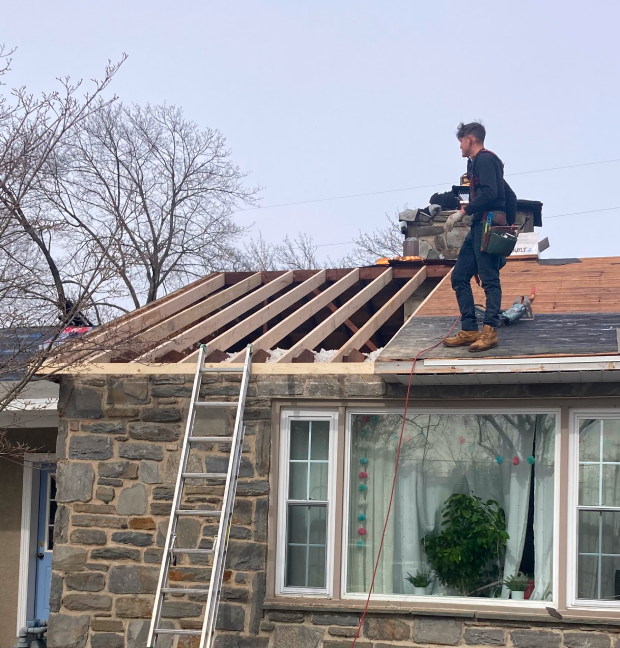
A skylight opening affects several layers of the roof. During a roof installation or reroofing project, the installer may need to coordinate the skylight with the roof covering, underlayment, flashing, and roof deck. NRCA notes that skylight installation and reroofing raise specific concerns involving flashing, insulation, vapor retarders, and condensation.
This coordination is especially relevant in older Delaware County homes. For properties with historic character or older roof assemblies, Strath Haven’s historic restoration services may be worth discussing during the consultation. A house in Swarthmore, Wallingford, Media, Rose Valley, or a nearby community may have undergone additions or previous renovations at different times. The skylight may not sit in the same roof assembly as the rest of the house, and a replacement must be compatible with the actual conditions found during the work.
The honest downside is that the visible skylight may be only one part of the project. If inspection reveals damaged sheathing or framing, the scope can grow because the installer must address the material that has been exposed to moisture. That is not a reason to avoid the work. It is a reason to identify the condition before closing the roof back up.
Read our roof installation guide for homeowners and roof installation mistakes in Delaware County before approving a project. You can also review Strath Haven’s roofing installation services to understand how a skylight project may fit into a larger roof installation. The goal is to understand what should be inspected and documented, not simply to choose the quickest visible fix.
Two Customer Experiences That Show Why Scope and Communication Matter
The following case studies are based only on the customer reviews supplied for this article. The reviews do not state that either project followed a storm, and no storm-related details have been added.
A Broad Roofing Scope That Included Flashing, Gutters, Skylights, and Copper Work
Chuck Di Carlo’s February 6, 2024 Google review describes a project that went beyond a single roof component. He wrote that Jim and the team handled “all my roofing needs, including flashing, gutters and downspouts,” and specifically praised the company’s skylight repairs and installation, flat-roof work, and copper work.
The review does not describe the original leak, the home’s age, or the condition that led to the work. What it does show is that the homeowner valued a team capable of considering several connected roofing and drainage components in one project rather than treating each item as unrelated.
The practical lesson is that skylight work should be evaluated in context. If the same roof area also has flashing, gutter, downspout, flat-roof, or copper details, ask for those interfaces to be reviewed during the consultation. Strath Haven’s gutter installation services may also be relevant when the project includes connected roof drainage work. Read the original Google review to verify the customer’s own words.
A 1.5-Day Roofing and Skylight Project with Permit Coordination
A second Google review, dated November 21, 2023, describes a project that included roof replacement, removal of two skylights, and installation of new gutters. The reviewer stated that the work was completed in “1.5 days,” and also noted that Jim Rothschild provided a detailed bid, secured the borough permit, and met his commitments promptly.
The review does not identify the municipality, the reason the skylights were removed, the roof materials, or the condition of the underlying deck. Those details should not be assumed. What the review does document is the homeowner’s experience with project scope, written planning, permitting, timing, and follow-through.
The practical lesson is to ask for the entire scope in writing before work begins. A skylight-related roof project may involve removal, replacement, gutter coordination, permitting, and sequencing. If concealed damage creates an urgent water-entry concern, Strath Haven’s emergency roofing repair services may be relevant while the permanent scope is determined. A detailed bid should make clear what is included and what conditions could change the scope. Read the original Google review for verification.
Questions to Ask Before Approving Skylight or Flashing Work
A consultation should give you enough information to make a decision without pressure. Ask the roofer to identify the suspected water-entry point, show whether the skylight itself was tested, explain the flashing approach, and note any signs of damage to the roof covering, underlayment, sheathing, or framing.
You should also ask whether the project requires a permit in your municipality, how the skylight work will be sequenced with roof installation, what happens if concealed damage is found, and how the completed work will be documented. These are practical questions, not signs that you are difficult to work with.
Be cautious if someone recommends a full replacement without explaining what failed, applies a generic sealant without reviewing the flashing, or cannot describe how the new skylight will integrate with the roof water-management layers. A trustworthy roofer should be able to explain both the recommended work and the reasonable alternatives.
For additional preparation, see our complete Delaware County roof inspection guide and why flashing matters.
Choose a Skylight and Flashing Plan That Protects the Whole Roof
A skylight should bring light into a home without creating a weak point in the roof. The most reliable way to prevent water damage is to evaluate the skylight, flashing, roof covering, underlayment, sheathing, framing, and drainage details together, then choose repair or replacement based on what the inspection actually finds.
Strath Haven Roofing & Restoration has served Delaware County since 1992. The company’s full-time specialists handle roofing, skylights, flashing, gutters, and related restoration work, with an emphasis on clear communication and quality craftsmanship.
Schedule a skylight and flashing consultation with Strath Haven Roofing & Restoration. The team will assess the water-management details, explain what is causing the concern, and help you determine whether a targeted repair or a larger installation plan makes sense, with no pressure and no surprises.
FAQ: Skylight Installation and Flashing Repair
How can I tell whether a skylight leak is caused by the skylight or the flashing?
You usually cannot determine the source from the ceiling stain alone. A proper assessment considers the skylight unit, frame, roof covering, underlayment, flashing, sheathing, framing, and interior evidence before recommending repair or replacement.
Can flashing be repaired without replacing the skylight?
Yes, a flashing repair may be appropriate when the skylight is sound and the problem is localized to the surrounding water-shedding details. The installer should confirm that the roof covering and underlying materials can be restored reliably.
Should skylights be replaced during a roof replacement?
Not automatically. Coordinating the work can make sense when the skylight is damaged, incompatible with the new roof assembly, or already near the end of its useful life. If the unit is sound, careful flashing and integration may be sufficient.